Blog Archive

Showing posts with label Moral Panics. Show all posts

Wednesday, 9 September 2015

Moral Panics


Critical Evaluation
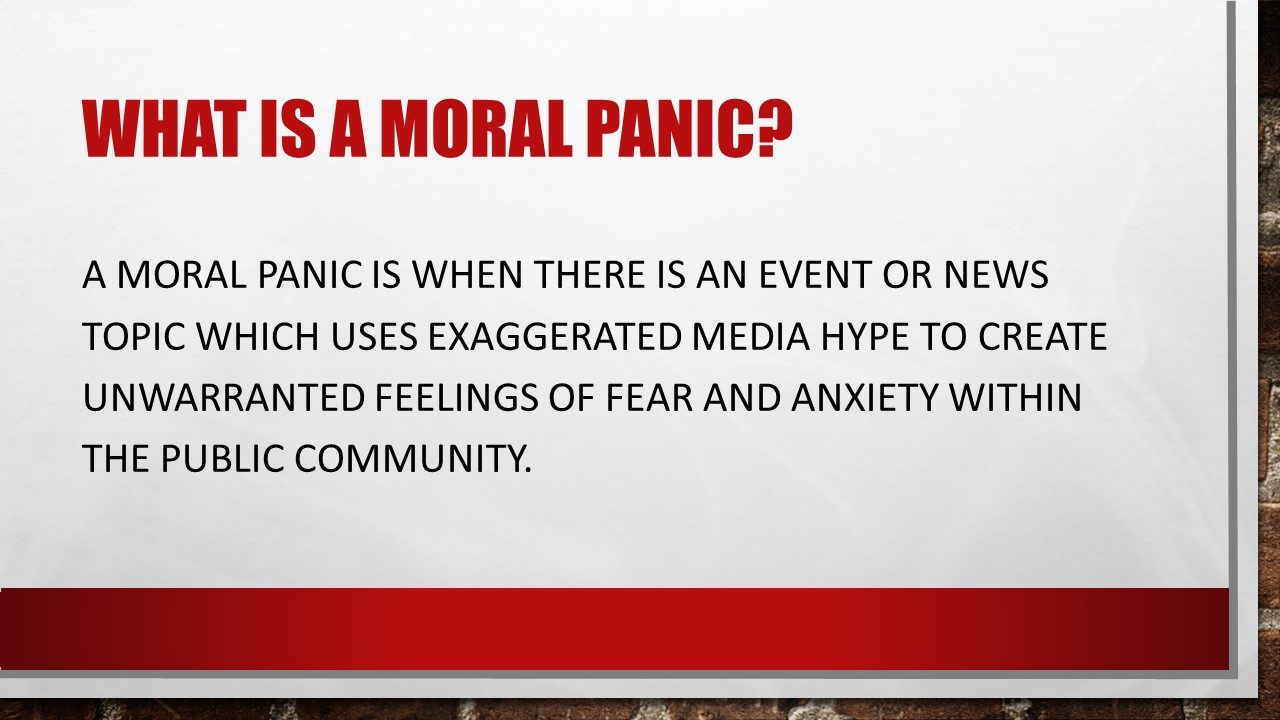
According to Stanley Cohen's audience effect theory, he theorised that the effect of a moral panic was to reassert hegemony by allowing a society to ascertain the values it does not accept.

Swine Flu
It can be argued that one of the media's main reasons for creating such a moral panic about swine flu was due to market share and profit. Tamiflu, a medicine for the treatment and prevention of flu, saw its sales increase considerably in 2009, with just over $3000m worth being sold, compared to that of 2004, when just approximately $200m was sold in the US.
The media demonised the flu as a threat to the world, during a time when most of the world and the UK were in a recession.
This moral panic came in a time when the public were very mistrusting of the government due to the economic situation. However, the media's description of swine flu as a global pandemic connoted an apocalyptic style, which detracted from this mistrust, particularly in the early reports of the influensa. Due to this, apocalyptic stories emerged on how viruses can be "weaponised", hence warning the public that terrorists could potentially attempt to infect the nation with influensa. This was further anchored by the use of the term "bio-terrorism" in the media, which not only invoked more panic, but also managed to create a common public enemy.

Celebrity Rapists
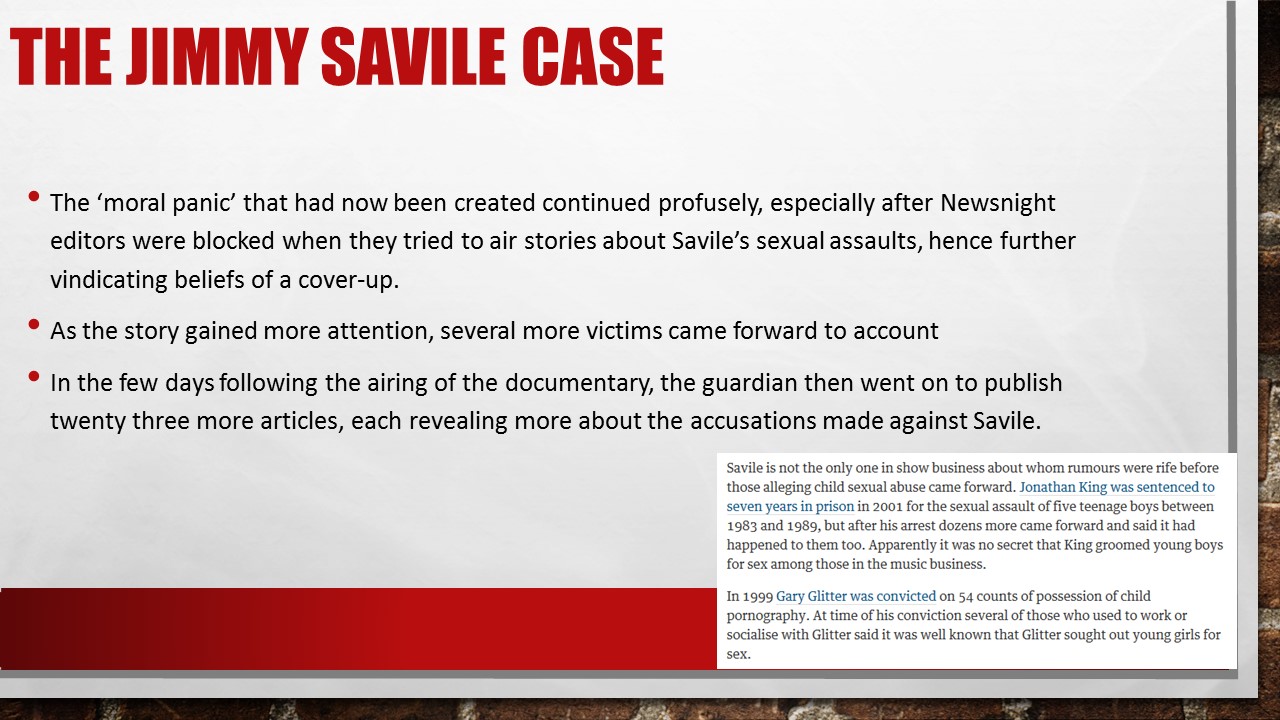
Jimmy Savile was an extremely high profile television and radio presenter who was known for doing "good deeds", particularly fundraising for several charities.
However, after his death, several allegations were made against him, and in January 2013 the Metropolitan Police and NSPCC published a report that stated that 450 complaints had been made against Savile.
Following this, a report was published by Operation Yewtree and entitles "Giving Victims a Voice." This report used elision and hyperbole to present the allegations made as "facts" and the accusations as "offences", leaving no doubt in the reader's mind that they must be true - even though the allegations could not be fully confirmed due to the death of the star.
Through the constant retelling of the Savile story, the public are reminded of the media assumptions and stereotypes of the innocence of children, particularly in regards to the adult world of sex, and also of the submissive roles women play to predatory men.
These all conform to common media representations within the media of men as being dominant and the "villain" and women and children as the "inferior victims" who need to be protected.
The moral panic created by this story, although essential as sexual abuse is a serious topic that needs to be acknowledged and discussed, had the primary focus of invoking fear and anxiety within the social world. Jock Young, who wrote about moral panics, argued that responses to social issues and anxieties "sometimes expressed in terms of demonisation, sometimes with humanitarian undertones" can be "grossly disproportionate to the event." This is a prime example of this, as what the media was suggesting was that a single individual could have "groomed a nation."
Also, moral panics are often used to detract from the structural/social dimensions of problems in society. This moral panic in particular was created during a time when there was a large amount of acute social anxiety in regards to public trust, particularly with attention on the behaviour of politicians, bankers, and the press.

Evaluation
Many films manipulate moral panics that are prominent in society, and so in order for our teaser trailer to be successful we will want to also adopt this technique. This blog post has offered several moral panics which we could use for our own film, such as the use of celebrity rapists.

Tuesday, 8 September 2015

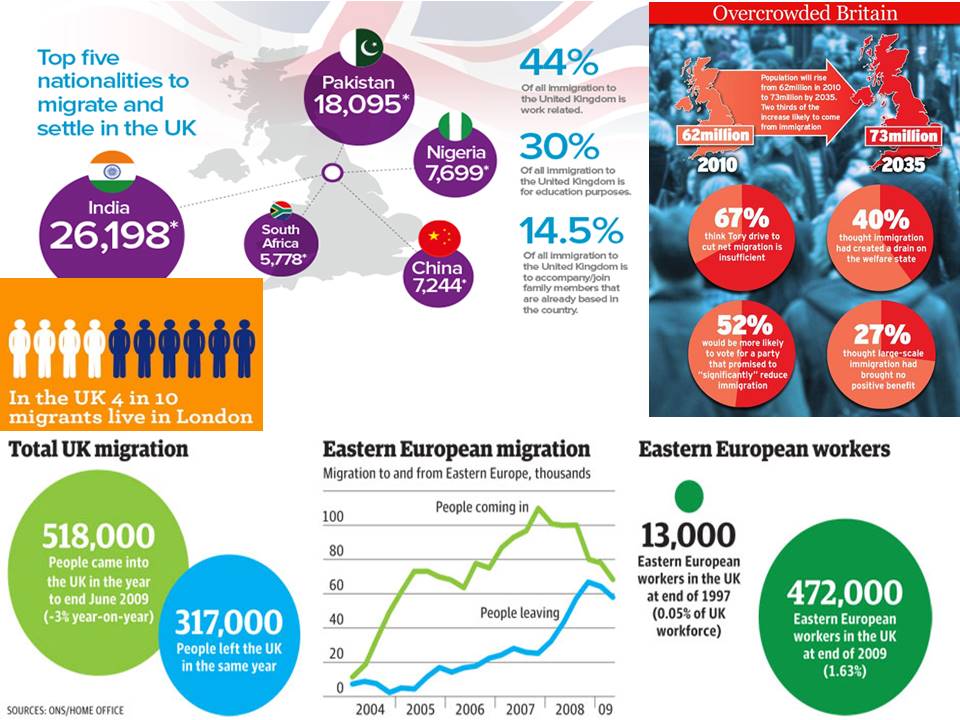
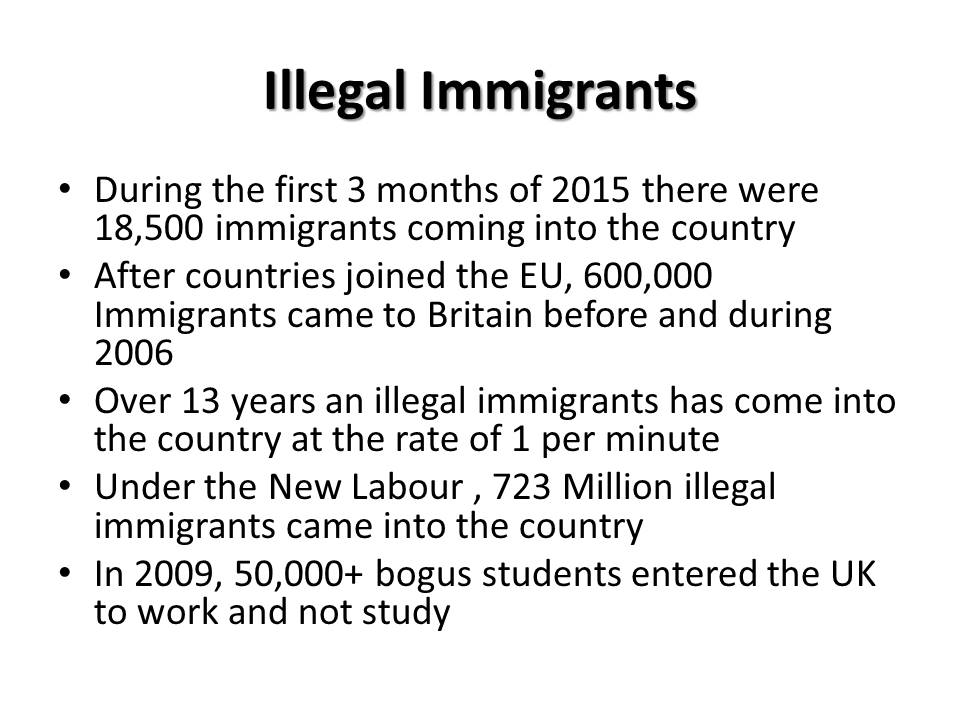
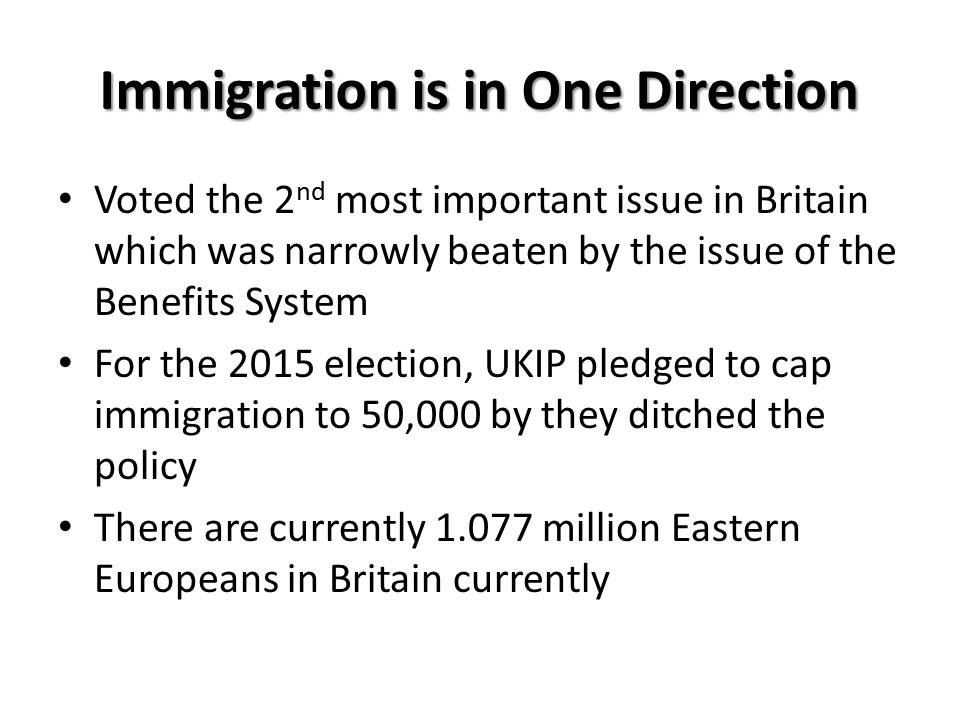
Moral Panics in the Media: Immigration: Why is the panic caused?


Why is this still portrayed in the Media?

  • This is still shown in the Media due to this being a current news story and due to the large impact it had on Britain and its roads as no one could get into or out of Britain or France due to the immigrants protesting and doing dangerous things to get over the Channel through the tunnel
  • This also affects millions of people regardless of whether or not they are the ones migrating into the country legally or illegally or if they are the people that already live in the country
  • Britain is one of the most affected countries in Europe and continues to be with all the new Syrian Refugees coming into the country and the new allowance of 20,000 more migrants and asylum seekers into the country as set out in a new policy by David Cameron (September 2015)  
  • The media overly publicise this in such a negative light due to them only showing the negatives of the situation such as more houses being built to accommodate them, them being given benefits and not working and how the immigrants get into the country
  • This is also portrayed in the media due to the 'racist' attitudes that can be seen through some areas of Britain.  The media uses this as prime examples of the 'bad' influence they have on our country and the economy to fuel the racist attitudes and anti-immigration attitudes.

Moral Panics in the Media: Heatwave


Why is this still portrayed in the media?

  • This is still portrayed in the media due to the large knock on effect it could have on the lives and health of many people around Britain.
  • This was the hottest summer was over 40 years ago so this was a huge event for Britain yet it was made overly dramatic by stating that several people had been taken into hospital because of heat stroke.
  • The media targeted the rare cases of heat stroke and blew them up to make the situation worse. They did this to show how unprepared Britain is to deal with 'extreme' weather conditions and this led to boasted market sales.
  • The market sales were on ice cream, sun cream, cold drinks and paddling pools but through the media they spawned a whole new unnecessary market of products to help cope with the heat wave.
  • As things such as dog suncream and sun hats for cats and dogs were marketed to help combat the heat wave, this created a cycle in which any behaviour such as abnormal purchases or heat stroke cases caused the media to keep publicising the heatwave and this in turn got them to purchase more of those items etc etc.

Moral Panics in the Media: Immigration


Monday, 7 September 2015

Examples of Moral Panics in the Media

Individually we were asked to find examples of two moral panics which we could find in the news from the last decade.

The 9/11 Terrorist Bombings
On September the 11th 2001, 19 people associated with the Islamic Terrorist group Al-Qaeda hijacked four aircraft and carried out suicide attacks against the united states, two of the planes were flown into the towers of the world trade center in New York, the third plane hit the Pentagon near Washington DC, and the fourth crashed in a field in Pennsylvania. The attacks resulted in a huge death toll which included people in the targeted buildings, pedestrians walking on the streets and rescue crews made up of police, firefighters and civilians who tried to rescue victims after the attack. 


This is a video collating different first reports of the attack, which gives a sense of the panic in the first few hours of the attack.


  • This news created a lot of panic in not only the US, but the world, because it set off a reaction that a terrorist attack was imminent in other countries. 
  • When it was first reported on FOX News, the news story cut off their normal headlines as it happened while the programme was on. The fact that the news readers seemed panicked and that it was breaking news, would have created panic in the audience also. 
  • During the coverage of the attack by FOX News, live footage was shown of the second plane attacking the tower. This would also create more panic because once the audience were getting to terms that there had been an attack, another one was shown. Using the live footage made it seem more real to the audience in that they couldn't detach from what was going on.
  • Also, callers were heard on the news coverage from witnesses of what happened, describing the scene and describing what they had seen. This also makes the audience empathise with them and realize that this has affected real people, which caused panic. 
  • The president of the time was also mentioned in the news coverage which again makes the audience panic because they have used the president, someone of the highest importance of america, to convey that this is an important event. 
       Critical view of the report
  • After the attack, FOX news in particular, created a constant colour chart that would be present on their reports. This colour chart would signify how a high of a threat America was in at that time from terrorism. This was very detrimental to viewers because it made them be on constant alert and created more of a panic.
  • Also, months after the attack, a rumor went across america that developers wanted to build a mosque on the site of where the twin towers used to stand. Because of this rumor, many hate crimes were carried out against Muslims, which of course was very detrimental towards them because the terrorist attack was done by a group of men that used Islam to sustain the attack, this did not mean that all Muslims felt the same way. Mass burnings of the Koran also took place across America. 
  • Due to the wide spread of the reports of the 9/11 attacks, it also seemed to have given terrorists 'Celebrity status'. Terrorists perpetrate these acts to inspire fear into people, but the huge media coverage just keeps this idea going for the terrorists, so many would do a big action just to get the media's attention. 
  • Another interesting idea which comes from the media keeping up the reports of terrorist acts. The media wants to create more and more fear in the citizens because the major media cooperations are owned by the government. If the citizens are fearful enough, the government can offer the citizens safety and promises like stopping attacks like this ever occur again, however in order to do that, they would explain they need to track everyone's phones and internet histories. Once this privacy is given up by the citizens the government can use this to their advantage in other areas, not just terrorist control.

The 2011 London Riots
  • The riots began after a protest on the 4th August 2011, because of the shooting of Mark Duggan by a police officer
  • between the 6th august and the 11th august, several London boroughs and many cities and towns across England looted and was involved in arson attacks in retaliation to the death of Duggan.
  • Youtube was flooded with videos of first hand accounts of the riots in London.  
  • Many took to videoing what was going around them in an effort to document what was happening through the eyes of the people living in that area.
  • videos showing buildings set alight and various groups of people looting shops and buildings were also shown
  • this creates panic because again, it is real footage so the audience can see for themselves what is going on. It could also bring more panic because this is happening in the capital of the country that they live in.